
Full Arch Dental Implants in Scranton, PA
We often take stability for granted until it is gone. A chair cannot stand without all its legs, and a bridge weakens when one section is left unsupported. The same concept applies to your teeth. When an entire arch is missing, the loss reaches beyond what you see in the mirror. It changes how your mouth functions every day. Chewing becomes less efficient, speech patterns shift, and the jawbone gradually loses the strength that once supported your facial structure. Restoring that foundation requires more than surface repair. Full arch dental implants restore what was lost from the root up.
By securing a complete set of teeth directly into the jawbone, they bring lasting strength and balance back to your bite. The result is a stable, natural restoration that allows your mouth to function as it was meant to.
Understanding the Benefits of Full Arch Dental Implants
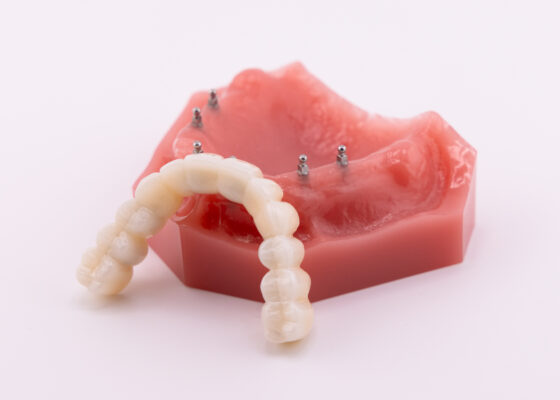
When we refer to full arch dental implants, we mean that several implants are placed throughout the upper arch, lower arch, or both to support a complete set of replacement teeth. We may recommend this treatment as part of full mouth reconstruction when multiple or all teeth are missing, or when existing dentures no longer provide the necessary fit, stability, or function. Patients who want a more permanent solution often choose full arch implants to improve comfort, restore strength, and maintain the natural shape of their face.
Each dental arch follows a natural curve that contributes to essential functions such as chewing, biting, and speaking. It also supports facial balance and proper alignment. Within each arch, the incisors, canines, premolars, and molars work together to maintain structure and distribute pressure evenly.
When those natural teeth are lost, the foundation that once supported these functions begins to weaken. To remedy this, we place small titanium posts into the jawbone, and over time, the bone bonds directly to each implant through a process called osseointegration. This biological fusion creates a stable connection between the implant and the jawbone, mirroring the strength of natural tooth roots. Because of this integration, full arch dental implants can withstand daily pressure from eating and speaking while preserving bone density. The result is a durable foundation that restores both the function and structure of a natural dental arch.
Full Arch Dental Implants vs. Traditional Dentures
Traditional dentures have long served as the foundation for full arch tooth replacement. They feature a gum-colored acrylic base that rests over the jaw and supports a full set of artificial teeth. The base is shaped to follow the contours of the mouth and covers the alveolar ridge where the natural teeth once sat. These dentures stay in place through suction and a precise fit against the gums, sometimes aided by adhesives to prevent movement.
While they restore basic function and appearance, traditional dentures can shift during eating or speaking because they rely solely on the soft tissues for support.
Modern implant dentistry builds on that foundation with solutions that add security and stability. The first step forward is the snap-on denture, which resembles a traditional denture but attaches to a series of dental implants that we place throughout the jawbone. These implants act as anchors, allowing the denture to “snap” securely into place with rubber O-rings.
A Closer Look at the Roundhouse Bridge
A roundhouse bridge restores an entire upper or lower arch with a single, continuous bridge that follows the natural curve of the jaw. Unlike traditional dentures, it does not include a bulky gum-colored base. Instead, it connects directly to the dental implants, creating a stable foundation that restores full function and a natural appearance. This design provides the closest experience to having a complete set of healthy, natural teeth.
When we take impressions for a roundhouse bridge, the restoration is later milled from a single block of zirconia as one continuous piece. The dental lab uses advanced design software to plan the shape and structure of the bridge with precision. Each tooth and contour is crafted to match the patient’s natural arch and bite. The result is a durable, lifelike restoration that functions much like a healthy set of natural teeth.
A roundhouse bridge can be completed as either semi-removable or permanent, giving patients two dependable options for full arch restoration.
With a semi-removable roundhouse bridge, we place roughly 6 to 10 mini dental implants along the jawbone. This method, known as the Fix-on-Six® implant system, keeps the bridge stable throughout daily activities. Patients do not remove it on their own; only Dr. Hazzouri, Dr. Genello, or Dr. Knott will detach it during routine visits for cleaning and maintenance. This option provides strong support while allowing for periodic professional care.
For a more permanently fixed option, we can cement the roundhouse bridge onto 10 to 12 mini dental implants. This solution most closely replicates the feel and strength of a healthy, natural set of teeth.
Rebuild Your Smile With Full Arch Dental Implants
If you are missing many or all of your teeth, or if your dentures no longer feel secure, full arch dental implants can restore the strength and stability your smile once had.
Schedule a free consultation at the Mini Dental Implant Center of America in Scranton. Our team will guide you through your options and help you restore a solid, dependable foundation for your smile.
Frequently Asked Questions
Insurance coverage for full arch dental implants differs from plan to plan. Depending on your policy, a portion of the treatment may be covered, particularly when implants are deemed medically necessary.
During your free consultation, we will review your treatment plan and provide a detailed cost estimate. Our team will also help you understand your insurance benefits and discuss the financing options available through our office.
Keeping full arch dental implants clean is essential for maintaining healthy gums and preventing peri-implant disease. Brush twice a day with a soft-bristled toothbrush, paying attention to the area around the implants and prosthesis. We also recommend using a water flosser to target hard-to-reach areas.
Professional cleanings are also vital, so be sure to schedule regular visits with our office. Routine checkups allow us to monitor the health of your implants and surrounding tissues.
Full arch dental implants are built for long-term durability and can last 25 years or more with consistent care. In many cases, they can last a lifetime. Their longevity depends on several factors, including good oral hygiene, regular dental visits, overall health, and avoiding habits such as smoking.
 English
  Spanish